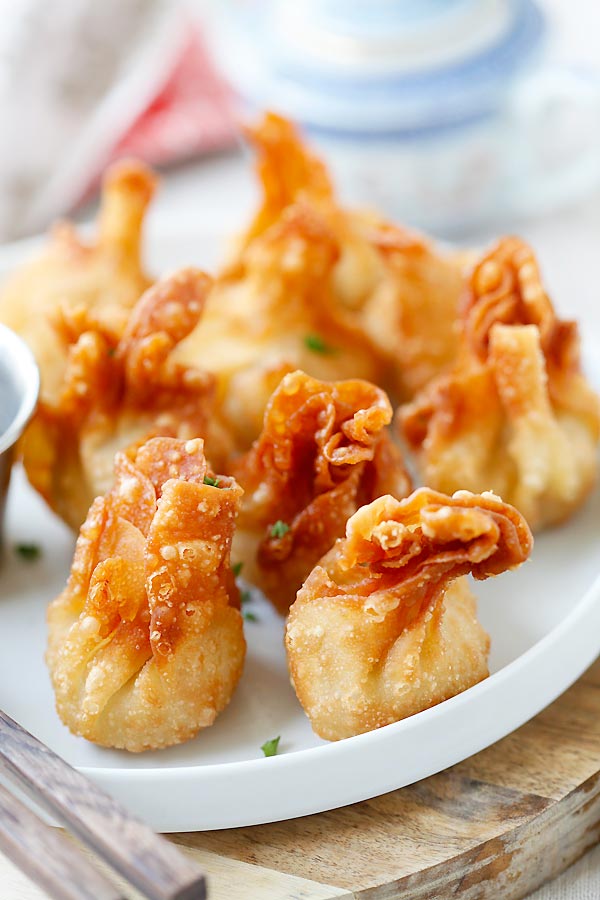
March 26, 2008

Pineapple Tarts Filling

Pineapple Tarts FillingSince my last post on pineapple tarts, I've received a few emails asking me about the filling--how it looks, the texture, the inside of the pineapple tarts--and I thought I would share this picture of pineapple tarts filling with you.

A perfect pineapple filling should be golden brown in color, with a sticky texture. The golden hue comes from the sugar added during the cooking process.

Last night, I made another two trays of pineapple tarts and converted them into pineapple shortcakes by adding 1 tablespoon of vegetable shortening. Oh my, what a phenomenal improvement--the pastry was soooooo crumbly it practically melted in my mouth. Needless to say, I finished all of them, again!

What about the 7 pounds I lost? Well, I've gained back 4...time for more salad and tofu! *wink*

View the inside of the pineapple tart after the jump....

Pineapple Tarts FillingTo read the original post and get the complete recipe of pineapple tarts, please click here.

Labels: , , ,


Continue Reading "Pineapple Tarts Filling"


March 23, 2008

Recipe: Pineapple Tarts/Pineapple Shortcakes (凤梨酥/菠萝酥)

Pineapple Tarts (凤梨酥/菠萝酥)(Click the above to view 7 pictures. Best viewed with Internet Explorer 7.)
It worked.

My self-imposing carb-free and sugar-free diet worked. Remember that annoying "I lost 40 pounds in 2 weeks" Google ad showing at the bottom of my post? Now, I can proudly have a banner up that says "I lost 7 pounds in 3 days!" All it takes was discipline, really.

After 3 days of eating organic greens, tofu, fruits, and soups, I developed a critical craving for carb and sugar--I needed a kick to my bland palate, I needed something loaded with carb, hopefully sweet and sinfully buttery. Then, I thought about the various pineapple tarts recipes that I have been saving for months. What a brilliant idea! Pineapple tarts have gotten everything that I was craving for: carb, check; pineapples, mmmm yum; sugar, oh yeah; butter, hell yeah!

And hence, two trays of buttery, sweet, flaky, delicious, and beautiful pineapple tarts were born in my kitchen. Thanks to my Malaysian friend Mandy at Fresh from the Oven, I couldn't get enough of them, and I am definitely saving her recipe for good...

Pineapple Tarts (凤梨酥/菠萝酥)(Pineapple tarts/凤梨酥/菠萝酥 are commonly baked for the celebration of Chinese New Year festival in Malaysia and Singapore. In Taiwan, pineapple tarts/凤梨酥 are exceedingly popular but the recipe calls for shortening and milk powder and taste slightly different. Because shortening is used in the Taiwanese version, they are also called pineapple shortcakes. )

Making these pineapple tarts (凤梨酥/菠萝酥) takes some patience, especially with the pineapple filling. As with every single baking project that I have undertaken, I cheated and took some shortcuts and luckily they worked out.

The pineapple tarts looked so photogenic I just had to put in some extra efforts to make them picture perfect, and I think they turn out to be quite Donna Hay worthy. What do you think?*wink*

(Don't forget to read the comments section of this post; things get a lot more interesting--and controversial--there.)

Recipe: Pineapple Tarts
Adapted from Fresh from the Oven
(Makes 24 tarts)

Ingredients:

For the pasty filling:

2 1/2 cups all-purpose flour
2 sticks butter (I used Challenge brand, which is recommended by Saveur magazine as one of the best butter brands in the US)
1/4 teaspoon salt
2 egg yolks
4 tablespoons confectioners' sugar/icing sugar
2 tablespoons cornstarch
1 tablespoon vegetable shortening (optional but it will make the tarts extra crumbly)
1 egg yolk (lightly beaten for egg wash)

For the pineapple filling:

2 cans (20 oz can) sliced pineapples
10 tablespoons sugar (more or less to taste)
1 teaspoon cornstarch (mixed with 1 teaspoon water)

Method:

Using low to medium heat, cook the drained crushed pineapple and sugar until most liquid has evaporated, and the filling turned golden. Stirring constantly using a wooden spoon to avoid burning. Taste, and add more sugar when needed. Add in the cornstarch to thicken the mixture. Set aside and let it cool in the fridge.

Sieve the flour, corn flour, salt and sugar into a medium bowl. Beat butter in a mixer until it turns light in color and fluffy. Add in egg yolks until well combined. Slowly beat in the flour mixture until just combined.

Divide the pastry dough and pineapple filling each into 24 equal rounds. Flatten the pastry dough with the palms and put the pineapple filling in the middle and use the dough to cover the filling. Use your palms to round it up and then shape it into a roll about 1.5 inch long. Use a fork to make criss-cross patterns on the tart and then brush it with the egg wash.

Preheat the oven for 350F and bake for 20-25 minutes or until light brown.

My shortcuts:
  1. For the butter, I didn't cream it with the electronic hand mixer. I nuked it in the microwave for 10 seconds and then mix everything together with hands. I know this is not the best shortcut because the heat in the butter might "cook" the flour.
  2. For the pineapple filling, drain the pineapple slices and then squeeze the extra water/juice with your hands. If you don't, it's going to take you an hour or more to make the pineapple filling.
  3. I didn't crush the pineapple slices manually, I dropped them into a mini food processor and blend them for 10 seconds.
  4. I didn't use low to medium heat to cook the pineapple fillings. I use high heat (but stir continuously) and then lower to medium heat. I don't have patience for low heat.
Note: Please use the shortcuts above with caution. It worked out for me, but I would advise you to follow the proper instructions instead of cheating like I did. ;)

Labels: , ,


Continue Reading "Recipe: Pineapple Tarts/Pineapple Shortcakes (凤梨酥/菠萝酥)"


March 16, 2008

Chinese Recipe: Fried Rice, Deluxe Version

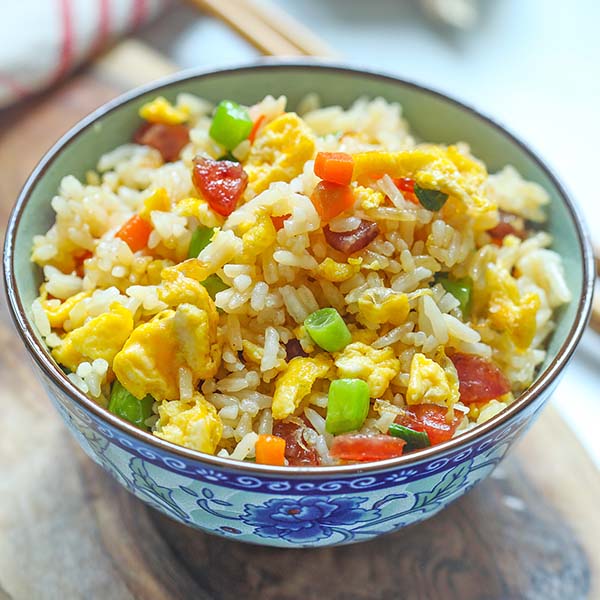
Chinese Fried Rice, Deluxe Version(Click the above to view 4 pictures. Best viewed with Internet Explorer 7.)
Chinese fried rice, everyone's favorite rice dish needs no further introduction from me.

As ubiquitous and simple as it is, there are probably dozens of fried rice recipes--plain, with chicken, shrimp, lap cheong (Chinese sausages), pork, beef, vegetables, kimchee, salted fish, eggs, or any combinations of the ingredients above and more. Regardless of the ingredients used, fried rice always pleases my palate and appetite.

What I had for dinner tonight was a deluxe version of Chinese fried rice. I love Cantonese chicken and salted fish fried rice (咸鱼鸡粒炒饭), but I also wanted Chinese sausage/lap cheong and baby shrimps in it, hence I came out with this deluxe version of Chinese fried rice....

The best fried rice calls for overnight rice. If overnight rice is hard to come by in your household, here is what you can do and you don't have to wait a day and a night for your rice to turn into overnight rice. The next time you have takeout or eat out at Chinese/Asian restaurants, get an extra serving of steamed rice. Keep it in your fridge for a night, and the next day, your extra steamed rice becomes the perfect overnight rice that you can use to make fried rice. I "cheat" like this all the time...it's so convenient.

Try this and I hope you will like it!

Recipe: Chinese fried rice with chicken, shrimp, Chinese sausage (lap cheong) and salted fish

Ingredients:

4 cups overnight rice
1 tablespoon fish sauce
1/2 tablespoon soy sauce
1/8 tablespoon salt
1/4 tablespoon sweet soy sauce (ABC Kecap Manis)
3 dashes white pepper powder
1 skinless and boneless chicken breast (cut into small cubes)
1 Chinese lap cheong/sausage (diced into small pieces)
1/2 cup baby shrimp
1/2 cup green peas
2 tablespoons cooking oil
2 cloves garlic (finely chopped)
2 eggs (light beaten)
1 small piece of salted fish (diced into small pieces)

Method:

Heat up a wok with two tablespoons of oil. Add salted fish and fry until aromatic, set aside. Using the same oil, saute the garlic until aromatic. Add in chicken, baby shrimp, Chinese sausage and peas and stir fry until they are half cooked. Season with salt and continue to stir-fry until they are 80% cooked. Add in the overnight rice and stir well with the ingredients. Add in soy sauce, fish sauce, sweet soy sauce, white pepper powder and continue to fry the rice for a couple of minutes.

Make a "well" in the middle of the wok and pour the beaten eggs in the middle of the rice. Wait for 30 seconds and then cover the "egg well" with the rice. Leave it for 30 seconds and continue to stir-fry the rice so the eggs form small pieces and mix well with the rice. Add in the fried salted fish and do some quick stirs, dish out and serve hot.

Labels: , ,


Continue Reading "Chinese Recipe: Fried Rice, Deluxe Version"


March 12, 2008

Recipe: Restaurant-style Chinese Greens with Oyster Sauce

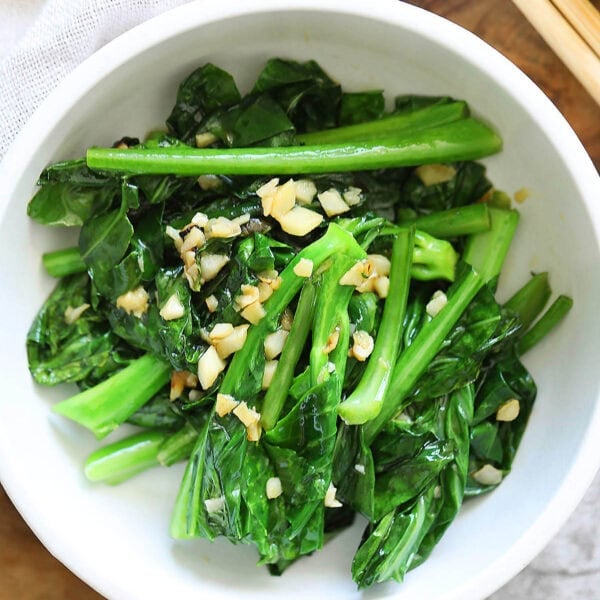
Restaurant-style Chinese Greens with Oyster Sauce(Click the above to view 4 pictures. Best viewed with Internet Explorer 7.)
I have been asked too many times how to make a simple Chinese greens dish ala Chinese restaurant style...so here it is, the secrets, tips, and recipe to make all your vegetables taste and picture perfect, just like top Chinese/Cantonese chefs do.

Chinese greens with oyster sauce is an easy dish to prepare but not many can make it right. I have seen too many overcooked vegetable dishes served—at homes and even at restaurants. Once you grasp the basic techniques and skills of making this dish, you can pretty much cook any vegetables or Chinese greens you want—choy sum, kai lan (Chinese mustard greens), bok choy/baby bok choy, or any green leafy vegetables.

Without further ado, I unveil the following secrets, tips and tricks after the jump....

Rasa Malaysia's Guide to Making Restaurant-style Chinese Greens with Oyster Sauce:

  1. Buy fresh vegetables – select the freshest greens available in your market. Such as the baby bok choy shown in my pictures.
  2. Use garlic oil – I use a lot of garlic oil in my Chinese cooking. It adds a lot of depth to simple dishes and infuses the veggie with garlicky flavor and aroma.
  3. Use cooking oil wisely – Add a drop or two cooking oil into the water before blanching the vegetables. The cooking oil coats the vegetables so they look fresh and green, not purple.
  4. Don't kill your vegetables, they are already dead! – Don't overcook your vegetables by leaving them too long in the boiling water. Perfectly blanched vegetables should be somewhat crunchy, not limp and wilted.
  5. Discard excess water from the vegetables before plating/serving – Drain the water from the vegetables so it doesn't dilute the sauce. Excess water in the vegetables will make your vegetable dish watery.
Now that you have the chops, complete your Chinese meals with a plate of fresh, green, and delectable Chinese greens. Trust me, vegetables never look or tasted this good from now on. :)

:::::::::::::::::::::::::::::::::::::

Want more garlic oil and oyster sauce Chinese cooking? Check out these recipes on Rasa Malaysia:
  1. Steamed Shrimp with Garlic Oil
  2. Stir-fried Napa Cabbage with Garlic Oil
  3. Ginger and Scallion Chicken
::::::::::::::::::::::::::::::::::::::

Recipe: Restaurant-style Chinese Greens with Oyster Sauce

Ingredients:

Your favorite Chinese greens (I used 6 baby bok choy for my dish)
1 tablespoon oyster sauce (Lee Kum Kee brand preferred)
1 tablespoon water
1/4 teaspoon cooking oil
1/2 teaspoon sugar
2 dashes of white pepper powder

Garlic Oil:

2 cloves garlic (finely chopped)
1 teaspoon oil

Method:

Prepare the garlic oil first by heating up your wok and stir fry the minced garlic until they turn light brown. Dish out and set aside.

Heat up a pot of water and bring it to boil. Add two small drops of cooking oil into the water. Drop your vegetables into the boiling water and quickly blanch them for about 20-30 seconds (depends on the quantity). As soon as they turn slightly wilted, transfer them out and drain the excess water off the vegetables. Arrange the vegetables on a plate.

In a wok, heat up the cooking oil, and then add the oyster sauce, water, sugar, and white pepper powder. As soon as the sauce heats up and blends well, transfer and drench it over the blanced vegetables. Top the vegetables with the garlic oil and serve immediately.

Cook's Note:

  1. For the garlic oil, the garlic will continue to cook in the oil so as soon as they turn light brown in the wok, you should dish it out. Eventually, they will turn golden brown. :)

Labels: , ,


Continue Reading "Recipe: Restaurant-style Chinese Greens with Oyster Sauce"


February 26, 2008

Recipe: Fish Ball Dim Sum (Steamed Fish Balls with Bean Curd Sticks)

Fish Ball Dim Sum (Steamed Fish Balls with Beancurd Sticks)(Click the above to view 3 pictures. Best viewed with Internet Explorer 7.)
One thing I don't like about eating dim sum in the United States is the lack of fish ball offerings. If you recall my previous posts about sweet and sour fish balls and yong tow foo, I am partial to fish ball-related foods: deep-fried, stuffed in vegetables or tofu (like Malaysian yong tow foo/酿豆腐), in soup, or steamed.

Whenever I go home to Malaysia and have dim sum, I would order trays after trays of fish ball dim sum. They are usually lightly fried and then steamed. Some of them are just plain steamed fish balls and some are pan-fried and drenched in savory bean sauce. Whichever way they are prepared, fish balls found in Malaysian dim sum restaurants are springy, utterly addictive (you just want more after the first taste) and delicious.

(They look like the following: the ones lurking on the right are plain steamed fish balls, but the ones to the left are lightly fried and then steamed. See the picture after the jump.)

Fish Ball Dim Sum (Steamed Fish Balls with Beancurd Sticks)So, when I crave for fish ball dim sum, I make mine at home. They are very easy to make because I cheat with store-bought fish paste. I add some chopped garlic into the fish paste and steam them over a bed of bean curd sticks, a trick that I learned from a dim sum restaurant.

These steamed fish balls are so good with chili sauce. I just can't get enough of them.

Yum!

:::::::::::::::::::::::::::::::::::::::::::::

Love the recipe? Here are more fish balls and dim sum recipes on Rasa Malaysia:
  1. Sweet and Sour Fish Balls
  2. Yong Tow Foo (Stuffed Tofu, Chili, and Okra with Fish Paste)
  3. More Yong Tow Foo
  4. Chicken Shu Mai
  5. Red Bean Paste Steamed Buns (Tau Sar Bau)
:::::::::::::::::::::::::::::::::::::::::::::

Recipe: Fish Ball Dim Sum (Steamed Fish Balls with Bean Curd Sticks)

Ingredients:

1/2 container fish paste (I used this)
2 cloves garlic (finely minced)
1/8 teaspoon sesame oil
3 dashes of white pepper powder
3 bean curd sticks
A pinch of salt
Some green peas (for garnishing)

Method:

Soak the bean curd sticks in hot water to soften them. Cut them into 1 1/2 inch pieces. Heat up a small pot of water and add in some salt. Drop the bean curd sticks into the boiling water to cook them. Remove the bean curd sticks from the water and arrange them on small dim sum plates.

Defrost the frozen fish paste and add in minced garlic, sesame oil, and pepper. Blend well and form them into balls and place them on top of the beancurd sticks. Garnish with a green pea.

Steamed the dim sum fish balls for 5 minutes. Serve hot immediately with chili sauce.

Labels: , ,


Continue Reading "Recipe: Fish Ball Dim Sum (Steamed Fish Balls with Bean Curd Sticks)"


February 16, 2008

Recipe: Pan-fried Prawns (干烧虾)

Pan-fried Prawns (干烧虾)(Click the above to view 9 pictures. Best viewed with Internet Explorer 7.)
It's late at night so I am going to write a very short post.

This pan-fried prawns recipe is probably one of the easiest but remarkably delicious recipes for prawns--fresh water prawns pan-fried with soy sauce, cooking wine, and a wee bit of sugar. In Chinese, this dish is called 干烧虾.

Pan-fried Prawns (干烧虾)Fresh water prawn is a great choice because of the texture of the prawns, and the juicylicious and rich taste in the heads. I love fresh water prawns a lot, the taste is probably second only to live spot prawns in my opinion. The best seafood doesn't always have to come from the sea...

Of course you can try this recipe with regular shrimp/prawn. They taste as good. I am partial to fresh water prawns because they are such beauty--just click here to view all my pan-fried prawns pictures and bon appetit!

::::::::::::::::::::::::::::::::::

Love Prawns? Check out other shrimp/prawn recipes on Rasa Malaysia
  1. Butter Prawns
  2. Dragon Well Tea Shrimp (龙井虾仁)
  3. Fried Shrimp/Prawn Balls with Wonton Skin (炸虾球)
  4. Steamed Shrimp with Garlic Oil
  5. Vietnamese Cha Tom (Vietnamese Shrimp Sausage)
  6. Vietnamese Tau Hu Ky (Bean Curd Skin with Shrimp)
  7. Shrimp Wontons
  8. Fried Shrimp Wrapped with Spring Roll Skin AKA "Firecracker Shrimp"
::::::::::::::::::::::::::::::::::

Recipe: Pan-fried Prawns (Fresh Water Prawns)/干烧虾

Ingredients:

6 fresh water prawns (or jumbo prawns or big prawns)
1 clove garlic (finely chopped)
1 teaspoon soy sauce
1 teaspoon rice wine or shaoxing wine
1/2 teaspoon sugar
1 teaspoon chopped scallions
1 teaspoon cooking oil

Heat up a wok with cooking oil. Drop in the chopped garlic and lightly saute till light brown. Add in the fresh water prawns, soy sauce, wine, sugar and do a few quick stir. Use the wok turner to press each prawn down (pan-frying) for both sides of the prawn. Add in the chopped scallions and serve hot.

Cook's Note:

1. The wok will get really dry and the prawns might appear burned but it's fine as it will add that "charred" flavor to the prawns.

Labels:


Continue Reading "Recipe: Pan-fried Prawns (干烧虾)"


February 08, 2008

Recipe: Chinese Jiaozi / Leeks & Pork Dumplings (韭菜饺子)

Chinese Jiaozi / Leeks and Pork Dumplings (韭菜饺子)(Click the above to view all pictures. Best viewed with Internet Explorer 7.)
There is an age old saying that Chinese people live to eat, or in Chinese "民以食为天." I am Chinese and I can strongly attest to the claim--Chinese people live for the sole purpose of eating and stuffing ourselves silly with food, food, and more food. If Maslow were to create a Maslow's Hierarchy of Needs for Chinese people, it would look something like this...

Chinese Hierarchy of Food Needs(OK, that was just me trying to amuse you. It's sad, but Level 5 is actually not a myth and some people--especially the wealthy--do eat them. But I will never EVER cross into Level 5.)

Hence, Chinese New Year is a celebration of marathon eating and drinking--throw in some gambling, firecrackers burning, karaoke-ing into the mix--for 15 glorious days. For more than two weeks straight (actually 16 days if you count New Year's Eve into it), we would be out and about looking for great eats--in restaurants, at home, at friend's and family's home, or just about anywhere we smell food. As a foodie, I simply looooove Chinese New Year.

Today, I am serving up a dish that most Chinese people (especially from Northern part of China) can't do without during the Chinese New Year's festivities--jiaozi /饺子 or Chinese dumplings. Ironically, born and raised in Malaysia, jiaozi/dumpling has never been a part of my family's dining table. In fact, I only discovered jiaozi when I attended college here in the US, where my Chinese friends from China would make buckets of them for the festival. Well, I must say that I am very lucky to have discovered this delicacy, and now I can't live without them.

The beautiful thing about jiaozi is its versatility. For the filling, you can pretty much use anything you want: ground pork is the most common ingredient, but you can also fill these jiaozi/dumplings with beef, chicken, shrimp, vegetables (for vegetarian jiaozi/dumplings), or be creative and do a filling of different combos. Once I dined at a Jiaozi restaurant (dumpling house) in Beijing and it serves no less than 30 different kinds of dumplings with every possible savory filling possible. It's simply mind boggling to decide which one to order, but suffice it to say, you can't go wrong with jiaozi, regardless of the filling.

Chinese Jiaozi / Leeks and Pork Dumplings (韭菜饺子)For today, I made a very traditional Chinese dumplings with leeks and ground pork filling (韭菜饺子). Other than time consuming, it's really not that hard to make these jiaozi. I was inspired by my friend Jen Yu at Use Real Butter.

Now, I dare you to make Chinese jiaozi/dumplings from scratch; it's fun and the rewards are remarkably satisfying and mouthwatering! Click here to view the complete food porn.

Similar Recipes on Rasa Malaysia:
  1. Shrimp Wontons
  2. Fried Wontons
  3. Chicken Siu Mai
  4. Fried Shrimp/Prawn Balls with Wonton Skin (炸虾球)
Recipe: Chinese Jiaozi / Leeks and Pork Dumplings (韭菜饺子)

Ingredients:

1/2 pound ground pork
1/2 cup of chopped chinese leeks (韭菜)
1/8 teaspoon salt
1 1/2 teaspoon rice wine
A few dashes of white pepper powder
5 drops of sesame oil

For the skin:

1 cup all-purpose flour
1/2 cup water

For dipping:

Black vinegar

Method:

Mix the flour with water and knead it for about 20-25 minutes or until the dough gets soft. Separate the dough into two equal portions and roll them into cylinders (about 1 inch in diameter). Cover them with wet towel and set aside.

Prepare the chives by chopping off the root (white part) of the chives. Use only the green part. Mix the chives with ground pork and add all the seasonings. Chill in fridge for 30 minutes.

To prepare the skin, cut the dough into 1/4 in. length and use a rolling pin to flatten it until it becomes a round skin about 3 inch in diameter. Put a small spoonful of filling into the center of the skin and seal it up tightly with your fingers. (No pleating is needed for this recipe).

Heat up a pot of hot water until it boils. Drop the dumplings into the boiling water and cover the pot. As soon as the dumplings start to float (meaning they are cooked), dish them out on a serving plate. Serve hot with black vinegar.

Labels: , ,


Continue Reading "Recipe: Chinese Jiaozi / Leeks & Pork Dumplings (韭菜饺子)"


January 18, 2008

Recipe: Braised Daikon/Turnip with Pork Ribs and Dried Oysters (白萝卜蚝干焖排骨)

Braised Daikon/Turnip with Pork Ribs and Dried Oysters (白萝卜焖排骨)(Click on the image above to view the complete photoset of 7 pictures)
To me, cooking is an act of discovery--the discovery of combining and pairing ingredients for a remarkably delicious meal. Sometimes, the discovery comes in a disguise and happens by chance, just like this scrumptious dish of braised daikon with pork ribs and dried oysters (白萝卜蚝干焖排骨).

I didn't learn this from the great cooks in my family--my late grandmother, my mother, or my aunt. I developed this recipe myself, not intentionally, but rather spontaneously. Sometimes, great things do happen with leftover ingredients in my fridge, in this case, daikon/turnip, pork ribs, dried oysters (previously I used them in my chicken congee/porridge), and dried wolfberries/goji berries.

This is a traditional Chinese preparation. Using low heat to slowly braise and cook the ingredients--preferably with a claypot--this cooking technique retains the natural flavor of the ribs while bringing out the sweetness of daikon and the briny taste of dried oysters. And the wolfberries completed the balance and taste of this dish with a tint of fruity sweetness...

Braised Daikon/Turnip with Pork Ribs and Dried Oysters (白萝卜焖排骨)
While this braised daikon with pork ribs recipe is probably not fine-dining or restaurant-worthy, it tastes so pleasing and homey that I strongly urge you to try it out. It's RASA MALAYSIA CERTIFIED 10-finger licking good!

(My pictures really don't do justice to my recipe. I mean, how can you make braised pork ribs+daikon+dried oysters+wolfberries any more photogenic?) *wink*

Recipe: Braised Daikon/Turnip with Pork Ribs and Dried Oysters (白萝卜蚝干焖排骨)

Ingredients:

1/2 pound pork ribs
1 daikon/turnip (medium-sized)
6-8 dried oysters (rinsed and soaked in water for 15 minutes)
1 tablespoon wolfberries/goji berries
1 1/2 tablespoons Chinese rice wine
1 tablespoon soy sauce
1/2 cup water
Salt to taste
Sugar to taste
1/2 tablespoon oil
6 cloves shallots (peeled)

Method:

Heat up a wok or claypot (preferred) and add in the oil. Sauté the shallots until slightly aromatic, then add in the dried oysters and daikon. Do a few quick stirs, follow by the pork ribs, rice wine, soy sauce, and water. Lower the heat to between medium and low, and then cover it up with a lid. Braise for about 20-30 minutes or until the water reduces and thickens. Add salt and sugar to taste and serve hot immediately.

Cook's Notes:
  1. If you don't like pork ribs, you can use chicken drumsticks. Just cut the chicken drumsticks into pieces, with bones in.
  2. You can use Japanese sake if you don't have Chinese rice wine.

Labels: ,


Continue Reading "Recipe: Braised Daikon/Turnip with Pork Ribs and Dried Oysters (白萝卜蚝干焖排骨)"


January 07, 2008

Recipe: Steamed Fish Rolls

Steamed Fish Rolls(Click on the image above to view the complete photoset of 5 pictures)
Inspired by Chubby Hubby's "Not Your Usual Egg Rolls" and "Steam Fish Rolls" by My Kithen Snippets, I made these fish rolls over the weekend.

These fish rolls call for two of my favorite ingredients--fish paste and eggs; they are not sushi, but fish paste wrapped with plain egg omelet and then steamed to mouth-watering perfection. (Previously, I'd used fish paste to make two kinds of Yong Tow Foo.)

Steamed Fish Rolls with While the two recipes above suggested brown sauce for the fish rolls, I opted for my special hoisin chili dipping sauce. The dipping sauce completed the dish with sweet, savory, and spicy flavors...I just couldn't stopped eating these fish rolls. They were simply yummy...

Enjoy!

Other fish paste and omelet recipes on Rasa Malaysia:
  1. Yong Tow Foo/Stuffed Tofu, Chili, and Okra with Fish Paste (酿豆腐)
  2. More Yong Tow Foo
  3. Imitation Shark's Fin and Crab Meat Omelette
  4. Rasa Malaysia Omelet
Recipe: Fish Rolls with Hoisin Chili Dipping Sauce
Adapted from Chubby Hubby and My Kitchen Snippets

Ingredients:

3 eggs (makes about 6 small fish rolls)
6 sheets of roasted nori or seaweed
1/2 pound fish paste or half a box of frozen fish paste
1 red chilli (deseeded and chopped into tiny bits)
1 stalk scallions (chopped into tiny bits)
1/4 teaspoon sesame oil
3 dashes white pepper powder
1/8 teaspoon salt
1 teaspoon Japanese mirin (optional)

Rasa Malaysia Special Hoisin Chili Dipping Sauce

Ingredients:

3 tablespoons Lee Kum Kee hoisin sauce
1 teaspoon chili garlic sauce

Mix the sauces together. If it's too salty or spicy, add 1 tablespoon or 2 tablespoons of boiled water to dilute it to fit your taste.

Method:

Defrost the frozen fish paste and add in chopped chili, scallions, sesame oil, and white pepper. Blend well and set aside. Beat the eggs and add mirin plus salt. Heat up a non-stick pan (I use a 9.5 inch diameter pan) and make about 6 thin omelets. Set aside the omelets and let cool.

Transfer an omelet onto a dry and clean chopping board. Lay a piece of roasted seaweed or nori on top of the omelet. Cut the edges of the seaweed sheet off so they match the shape of the omelet perfectly. Then, spread a thin layer of the fish paste evenly on top of the roasted seaweed sheet and roll the omelet up firmly. Seal the omelet with the fish paste so the fish roll is nice and tight. Repeat the same for the remaining omelets. (For picture instructions, please refer to My Kitchen Snippets.)

Transfer the fish rolls onto a plate and steam in hot boiling water for 8-10 minutes or until the fish paste fillings turn opaque. Cut the fish rolls into small pieces and serve immediately with the hoisin chili dipping sauce.

Labels: , , ,


Continue Reading "Recipe: Steamed Fish Rolls"


January 04, 2008

Recipe: Stir-fried Napa Cabbage

Stir-fried Napa Cabbage with Dried Shrimp and Straw Mushrooms (Click on the image above to view the complete photoset of 5 pictures)
A simple and delightful dish--stir-fried napa cabbage with dried shrimp (and straw mushrooms).

Straw mushrooms are optional but I put them into the stir-fry as I had some leftover in the fridge. Surprisingly, they transformed this humble recipe and added extra flavor, texture, and color to my stir-fried napa cabbage. I loved it!

If you are a Chinese-Malaysian or Chinese, I am sure many of you have had this dish growing up; perhaps you are still preparing it at home. It's one of those homey dishes that reminds you of your mother's--or your grandmother's--cooking...

Stir-fried Napa Cabbage with Dried Shrimp and Straw MushroomsI served my napa cabbage with a dollop of garlic oil and fried garlic on top of this dish. What a great idea. It infused the serving with garlicky aroma. You should try it, too!

To make other nostalgic and homey Chinese-Malaysian dishes, AKA the food of my childhood, please check out my recipes below (recommended and pair well with stir-fried napa cabbage):

  1. Malaysian Sweet and Sour Eggs (Eggs Masak Branda/Belanda)
  2. Stir-fried Eggs with Red Onions and Shrimp
  3. Bean Sprouts with Salted Fish
  4. Malaysian-style Ladies Fingers/Okras
  5. Pork Ribs and Lotus Root Soup
  6. Bean Curd Sticks and Pork Ribs Soup
  7. Stir-fried Bean Curds with Leeks
  8. Braised Bean Curd/Firm Tofu with Mushrooms
  9. Steamed Tofu and Ground Pork
  10. Steamed Eggs with Cincaluk/Steamed Eggs with Fermented Shrimp
Recipe: Napa Cabbage with Dried Shrimp (and Straw Mushrooms)

Ingredients:

3 cups chopped napa cabbage
6 straw mushrooms (cut into halves) - optional
3 cloves garlic (chopped finely)
2 tablespoons dried shrimp (soaked in warm water for 10 minutes, drained and set aside)
1 teaspoon oyster sauce
1 tablespoon cooking oil

Method:

Make the garlic oil first by stir-frying the chopped garlic with the cooking oil. Dish out half of it when the garlic turns golden brown.

With the remaining garlic oil in the wok, add in the dried shrimp and do a few quick stir until you smell the aroma of the dried shrimp. Add in the straw mushrooms and do a quick stir, then follow by the chopped napa cabbage. Stir fry for 1 minute and then add in the oyster sauce. Stir well and dish out the napa cabbage when it's still somewhat "crunchy" and not over-cooked. Top the stir-fried napa cabbage with the remaining half of garlic oil. Serve immediately.

Labels: , , , , ,


Continue Reading "Recipe: Stir-fried Napa Cabbage"


December 22, 2007

Recipe: Dragon Well Tea Shrimp (龙井虾仁)

Dragon Well Tea Shrimp (龙井虾仁) (Click on the image above to view the complete photoset of 6 pictures)
I haven't been dishing out too many home-cooked foods lately, as you all know, I was busy saving the world busy with Menu for Hope 4. The campaign ended with a whopping US$82,611.00 raised, so this means that I am back to my regular posting schedule and will be serving up even more scrumptious and mouthwatering food content for your reading and viewing pleasure.

Today, I would like to introduce you to a well-known Hangzhou dish called Longjing Xia Ren (龙井虾仁) or literally, Dragon Well Tea Shrimp. Infused with the aromatic and highly priced--and valued--Longjing tea, this dish pleases one's palate with the lingering fragrance of the tea and the crunchy texture of the shrimp.

Dragon Well Tea Shrimp (龙井虾仁)Longjing (Dragon Well) is a famous variety of green tea from Hangzhou (杭州) in the Zhejiang province in China. Renowned for its high quality and intensely fragrant body, Longjing tea is well regarded as one of the most famous teas produced in China. For your information, this tea is priced at US$40.00/lb or more in the tea shops here in the US...

I first had Longjing Xia Ren (龙井虾仁) in a Hangzhou restaurant in Beijing; my Beijing friend told me that Hangzhou cuisine is superior and one of the best in China and that I had to try it out. Prior to that, my friends in Shanghai also raved about the delicate cooking style of Hangzhou and that it's the "secret" why Shanghainese foods are so delectable. (Due to its proximity to Hangzhou, chefs in Shanghai have been adopting and incorporating the best Hangzhou elements into Shanghainese cooking.) I couldn't agree more after the first bite of the famed Dongbo Rou (东波肉/braised pork belly) and this very fine Longjing Xia Ren (龙井虾仁).

While the original recipe calls for tiny river shrimp native to that region, I opted for raw, peeled, and frozen baby shrimp--which coincidently is an import from Malaysia. The frozen shrimp lends that crunchy texture that I was looking for. With the simplest of ingredients, a wonderful dish was created and superb flavor delivered. I especially love that bitter tint of Longjing tea in the shrimp; it was out-of-this-world.

Dragon Well Tea Shrimp (龙井虾仁)Rasa Malaysia Suggested Chinese Menus

This Dragon Well Tea Shrimp will go well with the following recipes:
  1. Minced Chicken with Pork Rolls
  2. Pork Ribs and Lotus Roots Soup
  3. Steamed Scallops with Fermented Black Beans
  4. Stir-fried Chive Buds
Recipe: Long Jing Xia Ren (龙井虾仁) / Dragon Well Tea Shrimp

Ingredients:

1/2 lb raw, peeled & frozen baby shrimp
1 tablespoon Shaoxing wine
1/8 teaspoon salt or to taste
2 teaspoons oil
1 heaped tablespoon Longjing tea leaves
1/4 cup hot water
Some chopped scallion
1 tablespoon egg white
1 teaspoon corn starch

Method:

Defrost the frozen shrimp, rinse well, and pat dry with paper towels. Add corn starch and egg white to the shrimp and marinate for 15 minutes. Prepare the tea in a small tea pot by adding 1/4 cup hot water to the tea leaves. Set aside for 5 minutes and then filter the tea and set aside for the stir-fry.

Heat up 1 teaspoon cooking oil in a wok and toss in the shrimp. Do a few quick stir until the shrimp is 50% cooked, dish out and set aside. Wash the wok and heat it up again with the remaining 1 teaspoon cooking oil. Add the shrimp back into the wok, and quickly follow by the tea, Shaoxing wine, salt, and chopped scallion. Do a quick stir over high heat until the shrimp is cooked, dish out and serve immediately.

Labels: ,