February 01, 2008

Recipe: Penang Assam Laksa (Nyonya Hot and Sour Noodles in Fish Soup)

Penang Assam Laksa(Click the above to view all pictures. Best viewed with Internet Explorer 7.)
Before I start writing this post, I have a confession to make. I have an Asian (Chinese/Malaysian) mouth. In my gastronomic dictionary, it simply means that I can't live without rice and noodles, soy sauce, sambal belacan, spicy and pungent food--the foods of my Chinese-Malaysian root.

Just this past week, I had a massive Asian mouth attack. Granted, I savored some of the best French foods--foie gras, cheese, mussels, seafood, duck, terrine, and the list goes on. However, three days into eating meals after meals of immaculate French food, I got bored of it...it's too heavy and luxurious for my cheap taste. No offense to French cuisine connoisseur, I wanted something without cream or butter or sauces or excessive details; I wanted something simple and straightforward such as my Asian rice and noodle dishes--Hokkien mee, fried rice noodles, steamed rice rolls, char kway teow, chicken rice, and especially Penang Assam Laksa.

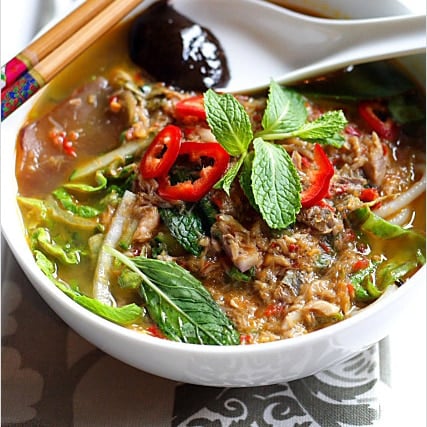
Penang Assam LaksaOn the flight back home, I knew that I had to make Penang Assam Laksa to cure my Asian mouth disease and fix my craving. So, I went to the market and assembled the long list of ingredients and made myself a small pot of Penang Assam Laksa, or Nyonya noodles in spicy and tangy fish broth/soup...

A staple--and arguably the most famous--hawker food in Penang, Penang Assam Laksa is very addictive due to the spicy and sour taste of the fish broth. Tamarind is used generously in the soup base and hence the word Assam (means tamarind in Malay). In addition to tamarind, assam keping or peeled tamarind is also commonly added to give it extra tartness. Another secret ingredient is Polygonum leaf (marketed as Vietnamese mint leaf in the United States) or daun kesom/daun laksa. While the best Assam Laksa broth is infused with the aromatic ginger flower (bunga kantan), I made without it because I couldn't find this special ingredient in the market. Of course, no Assam Laksa is complete without belacan and dollops of heh ko/prawn paste (the dark paste on the spoon).

Polygonum Leaves/Vietnamese Mint Leaves (Daum Kesom/Daun Laksa)Anyway, my Penang Assam Laksa was spot on--hot, spicy, sour, pungent, and full of flavors. It was very delicious and as good as the ones served by hawkers in Penang. At the first taste of this Penang Assam Laksa, I felt like being home. For now, I declare my my Asian mouth syndrome sorted...*wink*

Other "rice & noodles" recipes on Rasa Malaysia:
  1. Penang Char Hor Fun (炒河粉)
  2. Penang Hokkien Mee (Prawn Mee / Har Meen / Mee Yoke / 福建虾面)
  3. Claypot Chicken Rice (without Claypot)
  4. Penang Chee Cheong Fun/Steamed Rice Rolls
  5. Kerabu Bee Hoon
  6. Indian Mee Goreng/Indian Fried Noodles
  7. Fried Vermicelli Xiamen Style
  8. Indonesian-style Soto Ayam/Chicken Noodle Soup
Recipe: Rasa Malaysia Penang Assam Laksa

Ingredients:

1 lb Mackerel fish
8 cups water
5 pieces assam keping (peeled tamarind)
1 pack dried laksa noodles

Spice Paste:

12 dried red chilies (de-seeded)
5 fresh red chilies (de-seeded)
8 small shallots
2 teaspoons belacan
1 stalk lemon grass (use only the white part, about 6 inches)

Tamarind Juice:

Tamarind (about golf ball size)
1/2 cup water (repeat 3-4 times)

Seasonings:

1 teaspoon salt
2 tablespoons sugar
1 teaspoon fish sauce

Garnishing:

1 cucumber (julienned)
1 bunch mint leaves (use only the leaves)
1 bunch polygonum leaves/Vietnamese mint leaves (daun kesom/daun laksa)
1 bungan kantan (cut into small pieces)
1 red onion (sliced thinly)
1 lettuce (thinly cut)
1 red chili/3-4 bird's eye chilies (cut into small slices)
1 small pineapple (cut into short strips)

Condiment:

Heh Ko/Prawn Paste

Method:

Clean the fish, remove scales and guts. In a pot, bring 8 cups of water to boil. Add in the fish and boil for about 10 minutes. Transfer the cooked fish out into a bowl and let cool. Strain the fish stock, then add in the peeled tamarind, and the polygonum leaves and continue to boil in low heat.

Wet your hands constantly with a bowl of water, pick the flesh out of all the fish and discard the bones. Break the fish meat into tiny pieces and put the fish back into the stock, cover the lid, and lower the heat.

Using a mini food processor, grind the spice paste until fine. Heat up a wok and saute the spice paste with cooking oil for about 6-8 minutes or until it smells aromatic and spicy. Transfer the spice paste into the boiling stock.

Extract the tamarind juice and add it into the stock. Strain the tamarind juice and keep the seed. Repeat it 3-4 times with 1/2 cup of water each time to make sure you extract all the essence from the tamarind. Continue to taste your Assam Laksa stock to make sure it's sour and to your liking. For seasoning, add sugar, salt, and fish sauce.

Prepare the laksa noodles by following the packaging instructions. In a serving bowl, add in the laksa noodles and garnish all vegetables on top. Pour the Assam Laksa soup into the bowl and serve immediately with a spoonful of Heh Ko/prawn paste.

Cook's Notes:
  1. For the best laksa noodles, please use Mount Elephant brand "Guilin Rice Vermicelli" (象山牌桂林濑粉) found at Asian/Vietnamese stores. (In Vietnamese, it's called Bun Bo Hue Guilin.) It's very smooth and exactly like the laksa noodles back home. If you are lucky, you might even find the fresh ones.
  2. For a good alternative, try LaiFen Rice Stick/中山濑粉 from Guangdong, China.
  3. Fresh rice noodles or laifen/濑粉 are available in Asian grocery stores, but I don't like the texture: they are a tad too thick and not smooth enough.
  4. Canned sardines DO NOT make good Penang Assam Laksa. They make the soup base fishy and unappetizing. There is no shortcut to making great Assam Laksa, you just have to find certain freshest fish and make it from scratch.
P.S.: I heard that New York-based Chef Pelaccio of Fatty Crab fame claimed Assam Laksa to be the ultimate Malaysian dish. Personally, I think this Malaysian Assam Laksa fish soup tastes much better than French Soupe de Poisson (fish soup). *wink*

Labels: , ,


Continue Reading "Recipe: Penang Assam Laksa (Nyonya Hot and Sour Noodles in Fish Soup)"


February 28, 2007

Seafood Fest – Bukit Tambun, Penang

Bukit Tambun, PenangBukit Tambun--a quaint and small fishing village about 30-45 minutes across from Penang Island--is a seafood lover paradise. While Penang is blessed with a wide array of great seafood eateries, many Penangites often drive across the Penang Bridge to look for the best, freshest, and cheapest offerings. The answer is simple: sitting by a kuala (the river mouth where it meets the sea), Bukit Tambun is blessed with countless seafood restaurants dotting its main street and these restaurants offer loads of fresh bounties of the sea.

Bukit Tambun, PenangWhile I have tried out quite a few seafood restaurants at Bukit Tambun, my favorite is Gee Seng Seafood Restaurant at the end of the main strip. There are a few reasons I love it: 1) It’s one of the two restaurants floating on the river at Bukit Tambun, 2) There are many varieties to choose from, 3) The price is darn cheap, and 4) Last but not least, the taste of the seafood dishes are always heavenly.

I went there with my best friend and my niece tonight and here are the pictures of our catch.

Steamed Scallops, Bukit Tambun

Steamed Scallops, Bukit TambunA plateful of fresh scallops on the half shell; steamed with only soy sauce, garlic, bird’s eye chilies and shredded garlic, these sweeties are just RM11.00 or US$3.00. Now, I can’t even buy fake scallops with that money in the States!

Tom Yam Stingray, Bukit TambunTom Yam Stingray. Rasa Malaysia certified jilatable (lickylicious). It was so good I almost ate the soft bones of the stingray wings. Sour, spicy, and downright addictive, this is not the typical Tom Yam. A must have.

Mantis Prawns, Bukit TambunThese somewhat scary looking sea creatures are called Mantis Prawns. They are not the best looking seafood around and look like centipedes, but the flesh is sweet with a great texture.

Mantis Prawns, Bukit TambunAbove is the picture of the mantis prawn after you peel off the shell. In Penang, the best Hokkien Mee vendor tops his divine prawn noodles soup with these killer mantis prawns.

Nestum Prawns, Bukit TambunNestum Prawns. The crunchy bits (Nestum corn meal) were a tad too sweet and the aromatic curry leaves were missing in action. However, it was still a great dish considering the price was just RM14.00 or US$4.00.

Kam Heong Clams, Bukit TambunAs a die-hard clam lover, I had to have my clam-du-jour. Stir-fried clams “kam heong” (savory and aromatic) style was a mere RM7.00 or US2.00. Can you say “bargain?

Baked Crabs, Bukit TambunBaked mud crabs. This was the only dish that was disappointing; not that the chef didn’t know how to bake them, but they were too small for my taste. I love my crabs big, fat, and fleshy.

Chicken Satays, Bukit TambunTo wrap up the meal, I ordered some chicken satays from the hawker beside the restaurant. Perfectly charred and juicy with a tint of turmeric and lemongrass, they had me wanting for more.

Total damage of the meal (fresh coconut drinks and rice included) was only RM95.20 or US$27.00 for 3 people. With all these seafood sitting happy in my stomach, I think I will have a good night of sleep tonight.

Restaurant Makanan Laut Gee Seng/Gee Seng Seafood Restaurant
860 Bagan Bukit Tambun
14110 Simpang Ampat
Penang
Tel: 04-588-7220

Click here to view my photo album of Bukit Tambun. I love Bukit Tambun as it has a lot of character and very original. Wait no more, hop on a plane, car, train, or bus and visit Penang now; as much to offer and yet so cheap.

Labels: , , , ,


Continue Reading "Seafood Fest – Bukit Tambun, Penang"


February 26, 2007

Photoblog: Petaling Street and Jalan Alor, KL

Hawker food/street food is a big part of Malaysian culture and can be found anywhere in the country. If you are a foreign tourist to KL, don't miss out Petaling Street and Jalan Alor. A tad touristy, the foods are delectable nonetheless.

Here are some pictures snapped at Jalan Alor and Petaling Street during my whirlwind 36 hours in KL.

MangosteenMangosteen--the queen of all fruits--has a milky color flesh which is sweet with just the right tint of sourness.

A friendly street vendor in KL A friendly street vendor with his hot wok. His stir-fried Hokkien Mee is cooked with lots of wok hei (the breath of wok).

A Typical Open-Air Restaurant, Petaling StreetA very colorful and festive open-air restaurant at Petaling Street.

Portuguese Baked Fish Grilled Over FireAnother street vendor watching over his Portuguese baked fish wrapped with aluminum foil.

Claypot Chicken RiceClaypot chicken rice. This is how the the real stuff are done--with two electric fans fanning the charcoal flame.

View the complete set and take a virtual tour of the food scenes in KL...enjoy!

Related Post: 36 Hours in KL

Labels: , , ,


Continue Reading "Photoblog: Petaling Street and Jalan Alor, KL"


November 17, 2006

Photo Blog: My Favorite Shellfish

Every time when I go home to Penang, I like to spend my mornings going to local wet markets in search of fresh shellfish. Being an island, Penang is blessed with abundant supply of various kinds of shellfish and here are my favorites.

Kepah / ClamsKepah. They are very similar to Manila Clams, but their shells are smooth with glossy tint of colors. They are also heavy.

SiputSiput, my childhood favorite. I used to dig these beautiful Siput on the beaches in Batu Ferringhi. Unfortunately, they are hard to find these days.

LalaLala is a kind of soft-shell clam; the flesh is very tender and juicy. They are best stir-fried with soy sauce, shredded ginger, red chilies, and scallions.

BalitongEating Balitong requires training and skills. Suck the tail and the head alternatively to extract the flesh. They are absolutely delectable and here is the proof.

Razor ClamsRazor clams. There is another variety where the shell is straight, thin, and long.

Cockles / Bloody ClamsCockles. They are a must in classic Penang hawker food dishes such as Char Koay Teow or Penang Curry Mee.

Spikey Snail / 螺Spikey snail (螺). They are uncommon but the flesh has a crunchy texture and tastes sweet.

So, which is your favorite?

Note: I would love to learn more about the types of shellfish found in your location. Do drop me an email, a picture or two, if you would like to share.

Related Post: Stir-fried Savory Clams Recipe

Labels: ,


Continue Reading "Photo Blog: My Favorite Shellfish"


October 16, 2006

The Fruits of Malaysia

The Fruits of MalaysiaAlong the East-West Highway and interstate highways of Malaysia, one can find many fruit stalls selling various kinds of local fruits. As a fruit lover, I love stopping at these stalls in order to pick out my fruits-du-jour while traveling. There is no better way to tantalize the taste buds than to spend time here.

Fruit Stall in MalaysiaWhile these stalls are basically simple wooden sheds, they usually carry the freshest, most organic fruit in Malaysia. Often the fruit stalls are run by owners of local orchards and are not large commercial operations. Nothing against "Corporate Farm Capitalism" (how else could I eat oranges out of season grown half-way around the world) but only at these Mom-and-Pop stands is one assured to find the best selection of fresh, mouthwatering tropical fruits.

BananaBanana.

CempedakCempedak and Pineapples.

Fruits in MalaysiaSame family as Jackfruit, Cempedak is native to countries like Malaysia, Indonesia, and Brunei. The best way of eating Cempadak is to have them battered in flour and deep fried to golden brown. The seed is edible and the flesh is slightly sticky but absolutely tasty.

Petai / Stinky BeansPetai or stinky beans are best when cooked with sambal and shrimp. The said dish is classic Malaysian.

Buah Lam LayThese are Buah Rambai and they were my grandmother's favorite. They taste like Langsat, but slightly on the sour side.

HoneyHoney harvested from local orchards and villages; pure and organic to its very core.

Remember to stop by these fruit stalls the next time you are on the road. Trust me, it's fun!

Labels:


Continue Reading "The Fruits of Malaysia"


September 09, 2006

Five Things to Eat in Malaysia

As a newbie food blogger, I am two steps behind when it comes to the hot happenings in the food blogosphere. About a week ago I requested Passionate Eater to tag me for "Five Things to Eat Before You Die" started by Traveler's Lunch Box -- not knowing exactly what it meant by "tagging" (According to the rules of the kid's game, I quickly ran away).

After finding out that I had been tagged, I started to panic not knowing exactly what to do (OMG, I'm "it"). So for the next few days, I lurked around the blogosphere and finally realized that I needed to suggest my own "Five Things to Eat Before You Die" list in return (Passionate Eater - I am sorry this has taken so long!)...

As an insatiable foodie, it's a huge challenge to limit my choices down to just 5 foods. After much considerations and serious debate with others, I finally settled with the list of top 5 foods that I would like to share with you. As Rasa Malaysia is essentially a Malaysian food blog and the word "Die" is seemingly morbid in my dictionary, I have decided to take a lighter approach and give you "Top 5 Things to Eat (While Living) in Malaysia."
  1. Nasi Lemak
  2. Roti Canai
  3. Penang Assam Laksa
  4. Malaysian Satay
And last but not least, at number 5, Grilled Stingray wrapped in banana leaves.

Ikan Panggang / Grilled Stingray wrapped in Banana LeavesWhen live stingrays can prove to be fatal (well, you all should be aware of the sad incident by now), Malaysian Grilled Stingray is one of the best creations of Malaysian cuisine. Wrapped in banana leaves and seasoned with turmeric powder and other spices, this delicate fish is grilled to perfection and served with a condiment of Sambal Belacan with sliced shallots and lime juice.

There you have it -- the top 5 foods to eat in Malaysia -- remember, Malaysian food is not simply the five things I mentioned above. If you have the opportunity to travel through Malaysia, eat everything that looks interesting: not many places in the world have such varieties of food for your palate to experience.

OK, now you're it...

Labels: ,


Continue Reading "Five Things to Eat in Malaysia"


September 08, 2006

Recipe: Grilled Chicken Wings Jalan Alor Style

If you live in KL and haven't tried out Wong Ah Wah Grilled Chicken Wings at Jalan Alor, you don't know what you have missed out.

Located in the heart of downtown KL, Jalan Alor -- once notorious as a seedy red light district - is now a food haven casually known as "Wai Sek Kai," which literally means Glutton Road in Cantonese. When night falls, Jalan Alor turns into a giant open-air hawker center with coffee shops and food stalls serving all sorts of Malaysian street food delicacies; seafood, snacks, fruits, etc. Having so many great choices, the biggest issue of conscience you face is whether your stomach is big enough to accommodate the vast array of foods available. Jalan Alor is truly a foodie mecca!

When I think of Jalan Alor, Wong Ah Wah Grilled Chicken Wings naturally comes to mind. These chicken wings are famous; indeed, this flagship delight of Jalan Alor has now crossed the ocean and landed on the menu of Fatty Crab (not that Fatty Crab in KL), one of the hottest new restaurants in New York City. Once a resident of KL, Chef Zak Pelaccio launched this Malaysian joint to pay homage to the phenomenal food culture of Malaysia (finally, someone is doing justice to Malaysian food!)...

Reminiscing on the juicy and scrumptious taste of Wong Ah Wah's chicken wings, I took a stab at making them a few days ago. The real Jalan Alor Chicken Wings are so fine that my version was poles apart in terms of taste and presentation, but I took it very much in stride because there is no way one can top Wong Ah Wah when it comes to grilled chicken wings.

Ingredients:

10 - 12 chicken wings

For Marinate:

5 shallots (peeled and chopped into small pieces)
5 garlic (peeled and chopped into small pieces)
2 inches of ginger (peeled and chopped into small pieces)
1 teaspoon of dark soy sauce
5 teaspoon of soy sauce
3 dashes of white pepper powder
3 dashes of sesame oil
Sugar to taste
Salt to taste

Marinate the chicken wings for 12 hours. Grill over fire and constantly turning them so they are evenly grilled. Serve hot.

Note: Jalan means Road in Malay. KL refers to Kuala Lumpur, the biggest city in Malaysia.

Labels: ,


Continue Reading "Recipe: Grilled Chicken Wings Jalan Alor Style"